Showing posts with label art. Show all posts
Wednesday, 17 March 2010
Crayon Cookies
Following on from my last post on wax crayons, I thought I would introduce this project for Crayon Cookies which uses up all those odd bits and pieces of broken crayons that you always end up with.
Method
Remove all the paper from the crayons - I found this was easier if they were soaked in water for a few minutes first.
Using an old muffin tray, divide up the crayons between the different sections. The advice is to use an old muffin tin, but I thought I could get round this by using muffin cases - wrong! The wax still got onto the tin, but it did clean up quite easily with soap and really hot water. You can have great fun at this stage, the kids can get involved, and you can divide the colours out however you like. I decided to stick to colour families, so I used shades of green in one, shades of blue in another, pinks and purples in a third, and so on. The kids did a couple of 'harlequin' cookies, with a complete mixture of colours.
Place the tin in a warm oven which has been pre-heated to 150 degrees. As soon as the tin goes in, turn the oven off, and leave the crayons to slowly melt. It's quite difficult to judge this stage - at the end of the period, not all of my crayons had melted, so I turned the oven on again at a low heat and left it a little longer. However this resulted in them becoming a little too liquid! Possibly it depends on the performance of your oven.
When they have melted sufficiently for the individual crayons to have 'merged' but with the individual colours remaining distinct, carefully remove the tin from the oven and allow to cool.
I made my crayon cookies standard muffin size, which meant they were quite chunky for little hands to hold as crayons, and I had to cut them into quarters (this does have the advantage that it gives you a good point to use). If you want to cut them, I found that the easiest way to do it was to heat a good strong cutting knife over the gas flame, and use the hot knife to cut the cookie. Alternatively you could bake them as mini-muffins if you have the appropriate tin, though I think this would restrict you to only using the thinner crayons.
I can't remember where I came across the idea originally - it was in pre-blogging days, and I didn't take a note of it at the time, but in looking for some detailed insturctions I found this post by Ten Ten helpful.
Another tutorial by Chica and Jo, uses ice-cube trays with completely melted crayons in individual colours to create a more sophisticated crayon with layers of colour. They look wonderful, but I decided I didn't have the patience for this. You can find it here.
Friday, 12 March 2010
Art Materials - Wax Crayons
It's been a little while since I started this series off with Canvas, and I thought it was about time I continued it. This time I'm going to look at that staple tool of any self-respecting budding artist - wax crayons. Traditional, cheap, practical, easy to use, these are so ubiquitous that their creative potential is perhaps sometimes a little overlooked. Personally I have found that all wax crayons are not alike. They differ amazingly - you can get short fat stubby, chunky crayons, or long, thin ones. Some are hard and plasticky, others (perhaps unsurprisingly) soft and waxy. Some will produce a dense, bright colour, others a pale washed-out colour. Unfortunately, you can't tell just by looking at them how effective they will be, and price doesn't always seem to be a guide either. Some of the best I have found have been given out as freebies at restaurants.
Wax crayons are really effective for colouring large areas quickly and for creating large, simple drawings, but their unique characteristics make them especially suitable for the following kinds of projects:
Texture rubbings
Leaves, bark, brass rubbings, coins, wood grain, stone - lots of fun can be had with a piece of paper and a wax crayon - it's something that everyone must have done at some time or another - simple, but magical to a child, as an image appears before their eyes.
Resist Work
This technique exploits the water-resistant qualities of wax crayons. Again simple yet very effective. You create your drawing in wax crayon, and wash over it with a watery paint. You can get different effects depending upon how thick the paint is, and the colour of the drawing beneath. Used with a very watery paint and a white crayon, the effect is light and delicate, but wash over a bright wax crayon drawing with a denser black paint (not too thick or the paint will simply obliterate the drawing) and the effect is much richer and more dramatic. Alternatively, if the pictures are small you can use a felt tip marker pen over the wax crayon (see Really Rachel's Magic Pictures). To get the best effect, the wax crayon has to be applied fairly densely under pressure, which requires some strength to do. For this reason, very young children are likely to need some help with the drawing.
Sgraffito
This technique has 3 stages and is most suitable for older children who have more strength to apply the necessary pressure.
1. Create a colourful background with wax crayon, felt tips or paint (or cheat and use colourful paper)
2. Cover it densely with black wax crayon, applying as much pressure as possible.
3. Using something like a cocktail stick, draw your picture by scraping away the black wax crayon and revealing the coloured surface below.
The same effect can be created rather less cheaply using Crayola Color Explosion - Rainbow
paper and pens. I bought some of this for my kids (OK it was for me really) and they (or me) had great fun with it.
Wax crayons have lots of creative potential, so if anyone else has any projects they've created using them, feel free to add a comment with a link below. In the meantime, here are one or two that I have already come across:
Valentine's Card Water-painting
Leaf Rubbings
Magic Pictures
Wax crayons are really effective for colouring large areas quickly and for creating large, simple drawings, but their unique characteristics make them especially suitable for the following kinds of projects:
Texture rubbings
Leaves, bark, brass rubbings, coins, wood grain, stone - lots of fun can be had with a piece of paper and a wax crayon - it's something that everyone must have done at some time or another - simple, but magical to a child, as an image appears before their eyes.
Resist Work
![]() |
| A dark wash over bright crayon creates strong contrast |
![]() |
| A pale wash over white crayon creates a delicate effect |
Sgraffito
![]() |
| First create a brightly coloured background |
1. Create a colourful background with wax crayon, felt tips or paint (or cheat and use colourful paper)
2. Cover it densely with black wax crayon, applying as much pressure as possible.
3. Using something like a cocktail stick, draw your picture by scraping away the black wax crayon and revealing the coloured surface below.
![]() |
| Add a dense black layer of crayon over the top, and scratch a design or picture into it. |
![]() | ||
| This example was created with a felt-tip background |
The same effect can be created rather less cheaply using Crayola Color Explosion - Rainbow
![]() |
| Firework scene created with Crayola's Colour Explosion paper and pens |
Valentine's Card Water-painting
Leaf Rubbings
Magic Pictures
Labels:
art,
Children,
resist work,
sgraffito,
texture rubbings,
wax crayons
Friday, 5 February 2010
Creativity for Boys
I feel the need to get on my soapbox again - it doesn't happen very often, but increasingly, as the mother of 2 boys, I feel the need to defend their right to be creative, though it seems a little ridiculous that I should feel that way. Over the Christmas holidays, we took a family visit to the Museum of Science and Industry in Manchester (MOSI). It's a wonderful free resource, full of steam engines, trains, planes, cars and other bits of technology, and they also have an interactive hands on science gallery specially for kids. Being the holiday period it was busy, with lots of boys and girls. While we were there they set up a creative activity to make a decorative snowflake or other decoration, which basically involved lots of glue, scissors and glitter. As I approached it, my husband said to me 'we've found the girls' table' - and he was right, it was surrounded by about 20 small girls and their mothers, with not a male in sight. Fortunately this did not put my son off, and he happily approached and got involved, but there were plenty of other boys around in the gallery, and there didn't seem to be anything inherently female about the activity.
All this got me thinking. I have already noticed that there seem to be many more creative activity kits out there aimed at girls than there are at boys, and while there is nothing stopping me buying them for a boy, the packaging might put a boy off from using it if he feels it is too girly (boys are often sensitive to these things). In nursery, creativity does not seem to be gender specific, but once they get a little older it seems that boys, if they are creatively minded, are steered towards model building and science and engineering style projects. My son once indicated he wanted to learn to knit and sew, and my husband's humorous response to this, was to utter words to the effect of 'over my dead body' - now he wasn't serious, but the comment was made. If he still wants to learn (he hasn't mentioned it recently) I'll be happy to show him. Even some of the activity kits which aren't so obviously feminine in nature, are often packaged in a girly way. The overall impression I get from all this, and which niggles away uncomfortably in the back of my mind is that we are not really encouraging boys to be creative in the way that we encourage girls, and that this is largely an unconscious attitude - the worst kind, because we aren't even aware of it.
Now I should say at this point, that I am talking very much in general terms. I know there are some artistic and crafty kits out there aimed at boys, and that art materials are not gender specific, it's just that there seem to be more for girls, and I have yet to see an introductory sewing kit aimed at boys, or even one that is genuinely gender neutral.
This is not a recent thing - when I was at art college many years ago now, 75% of students on the course were female - and that was for Fine Art - not an especially female subject you'd have thought. I'm not sure if it would still be the same today, but I suspect it is. In contrast, if you looked at the most successful visual fine artists of today, I think you'd find that a disproportionately high number would be male. Maybe that just mirrors lots of other disciplines, where the same thing seems to happen, and is a whole other topic. It seems that there is a 'science is for boys, arts subjects are for girls' attitude coming into play - an attitude that starts quite early. So, in the light of all this I think it is important for me to do what I can to encourage artistic creativity in my boys, in whatever form it takes.
Right, I shall get off my soap box now. I have no doubt that some of you will think I am talking complete and utter rubbish here, and maybe I am, indeed I hope so, for the sake of male creativity in its widest form!
All this got me thinking. I have already noticed that there seem to be many more creative activity kits out there aimed at girls than there are at boys, and while there is nothing stopping me buying them for a boy, the packaging might put a boy off from using it if he feels it is too girly (boys are often sensitive to these things). In nursery, creativity does not seem to be gender specific, but once they get a little older it seems that boys, if they are creatively minded, are steered towards model building and science and engineering style projects. My son once indicated he wanted to learn to knit and sew, and my husband's humorous response to this, was to utter words to the effect of 'over my dead body' - now he wasn't serious, but the comment was made. If he still wants to learn (he hasn't mentioned it recently) I'll be happy to show him. Even some of the activity kits which aren't so obviously feminine in nature, are often packaged in a girly way. The overall impression I get from all this, and which niggles away uncomfortably in the back of my mind is that we are not really encouraging boys to be creative in the way that we encourage girls, and that this is largely an unconscious attitude - the worst kind, because we aren't even aware of it.
Now I should say at this point, that I am talking very much in general terms. I know there are some artistic and crafty kits out there aimed at boys, and that art materials are not gender specific, it's just that there seem to be more for girls, and I have yet to see an introductory sewing kit aimed at boys, or even one that is genuinely gender neutral.
This is not a recent thing - when I was at art college many years ago now, 75% of students on the course were female - and that was for Fine Art - not an especially female subject you'd have thought. I'm not sure if it would still be the same today, but I suspect it is. In contrast, if you looked at the most successful visual fine artists of today, I think you'd find that a disproportionately high number would be male. Maybe that just mirrors lots of other disciplines, where the same thing seems to happen, and is a whole other topic. It seems that there is a 'science is for boys, arts subjects are for girls' attitude coming into play - an attitude that starts quite early. So, in the light of all this I think it is important for me to do what I can to encourage artistic creativity in my boys, in whatever form it takes.
Right, I shall get off my soap box now. I have no doubt that some of you will think I am talking complete and utter rubbish here, and maybe I am, indeed I hope so, for the sake of male creativity in its widest form!
Friday, 22 January 2010
Art Materials - Kicking off with Canvas
`

I am introducing a new regular informative series to Artful Adventures on the subject of Art materials - I'm not sure yet quite how regular this will be, but there are lots of art materials out there, with new ones being introduced all the time so there's plenty of material to go at (no pun intended). I thought I'd kick off with canvas, the most traditional ground for painting, which has undergone such a surge of popularity in recent years.
Canvas, when used as a support for painting, is usually stretched tightly across a wooden stretcher. Traditionally, these canvases were then framed, though the fashion today is usually to leave them unframed. Because it was a linen or cotton canvas (the old masters often used hemp which is no longer available) a natural material which will absorb moisture from the air and lose tension over time, canvases were designed to have the capacity to be tightened further at a later date by knocking in small wedges to the corner joints at the rear of the canvas. Following stretching, the traditional manufacture of a stretched canvas involves painting a coating of glue size over the natural canvas fabric, followed by several coats of primer. This is to prevent the paint soaking into the material which can ultimately cause it to rot over time. The primer also gives a bright white background to paint on, giving subsequent paint layers greater brightness and luminosity. It can also give a smoother surface, though part of the attraction of canvas today is its textural quality. The disadvantage of canvases, especially large ones, apart from the tendency to sag over time, is that they can warp or twist. The quality of the stretcher itself is therefore important. The wood needs to be strong and well-seasoned and the frame needs to have enough bracing to prevent distortion. Lots of this I have learned by experience - I now only buy quality stretchers for Artful Kids, and have moved to using a polyester based canvas for printing which is less prone to sagging, as it does not absorb moisture. For painting, the best quality canvases are made using linen, but this is quite expensive, so most of what is available cheaply and ready made will be cotton, though this is less stable and can be prone to mildew.
As with most things, you can make your own canvases from scratch - I was taught how to do this at art school, but my canvases always seemed to be a bit skew-wiff (I don't have brilliant woodworking skills). However if you are after a size of canvas that is not easily available, you can buy the stretcher bars and braces separately (with pre-cut joints), knock them together and stretch your own. Getting even tension across a large canvas can be tricky however and takes practice. For standard and especially smaller sizes, it is generally no cheaper to make your own than to buy ready made, especially if you're not too concerned about the quality. Buying in bulk also cuts down the cost if you are doing some work with a group of children.
Of course canvas doesn't have to be stretched, and unstretched it takes on more of the character of a textile hanging - this too has a history. During the medieval and Tudor periods, if you couldn't afford to have a genuine tapestry on your wall, you'd hang a 'stained' - or painted linen hanging on your wall instead. At a later date painted and stencilled cloths were also used on the floor as an early form of cheap carpet, and the forerunner of linoleum. When painting on unstretched canvas, you have to restrict yourself to thinner layers of paint to prevent cracking and flaking, unless you are using purpose designed fabric paints.

The current popularity of canvases means that you can pick up ready stetched and primed canvases pretty cheaply these days, especially in smaller sizes, but though you may occasionally let your children loose on one, it would be extravagant to let young children them use them all the time. They're good to use for special occasions, and also for those simple but effective techniques where you can't really go wrong, and are most likely to produce an effective result (for example hand and footprints, splatter painting etc) that you intend to hang on a wall. However, I recently came across a product at the Early Learning Centre which allows your child to paint on canvas on a regular basis, and wash it when you want to use it again. It did occur to me that as it appeared to be nothing more than a 1m square of canvas fabric that has been hemmed at the edges, this would be very easy to make yourself, but possibly they have treated it in some way to become stain resistant. (I'm afraid I have an almost reflex action when looking at anything I like, that automatically causes me to consider whether I could make it myself. Being brought up in an 'economically challenged' family was a great stimulus to my creativity!) The advantage with this is that if your 2 year old does unexpectedly create a masterpiece, you can keep it unwashed and hang it on the wall, or even have it stretched perhaps. After all for £10 it's not particularly expensive.

If you want the textured effect of canvas, but are not particularly interested in the bulk of a stretched canvas, then you can buy canvas board
- this is essentially a hardboard base with a white primed canvas style surface. It feels different to paint on, as it does not have the same 'give' or flexibility as a stretched canvas, but at times this might be an advantage. Canvas board has the advantage also that if the size is appropriate, instead of hanging it on the wall, you can add some felt to the back and use it as an artistic place mat. Again you can make your own canvas board much more cheaply, but you have to weigh up whether the extra hassle is worth it.

For sketches and preliminary work or where you want the effect of canvas without too much hassle or expense, there are the pads or blocks of paper designed for oil and/or acrylic work. Canvas paper
has a linen effect texture which can be used quite effectively with pastels, crayons and charcoal as well as with paint. A sheet can always be mounted or glued onto board if more support is required.
This is only intended to be a very basic introduction to canvas as an art material - hopefully I haven't bored everyone rigid, but for anyone with a more serious interest in finding out about canvas as a painting support, there is of course lots more material out there on the internet. A few examples are given here:
Making a Hand Made Canvas for Painting on
How to Prime and Stretch a Canvas
The Artist's Canvas

Canvas, when used as a support for painting, is usually stretched tightly across a wooden stretcher. Traditionally, these canvases were then framed, though the fashion today is usually to leave them unframed. Because it was a linen or cotton canvas (the old masters often used hemp which is no longer available) a natural material which will absorb moisture from the air and lose tension over time, canvases were designed to have the capacity to be tightened further at a later date by knocking in small wedges to the corner joints at the rear of the canvas. Following stretching, the traditional manufacture of a stretched canvas involves painting a coating of glue size over the natural canvas fabric, followed by several coats of primer. This is to prevent the paint soaking into the material which can ultimately cause it to rot over time. The primer also gives a bright white background to paint on, giving subsequent paint layers greater brightness and luminosity. It can also give a smoother surface, though part of the attraction of canvas today is its textural quality. The disadvantage of canvases, especially large ones, apart from the tendency to sag over time, is that they can warp or twist. The quality of the stretcher itself is therefore important. The wood needs to be strong and well-seasoned and the frame needs to have enough bracing to prevent distortion. Lots of this I have learned by experience - I now only buy quality stretchers for Artful Kids, and have moved to using a polyester based canvas for printing which is less prone to sagging, as it does not absorb moisture. For painting, the best quality canvases are made using linen, but this is quite expensive, so most of what is available cheaply and ready made will be cotton, though this is less stable and can be prone to mildew.
As with most things, you can make your own canvases from scratch - I was taught how to do this at art school, but my canvases always seemed to be a bit skew-wiff (I don't have brilliant woodworking skills). However if you are after a size of canvas that is not easily available, you can buy the stretcher bars and braces separately (with pre-cut joints), knock them together and stretch your own. Getting even tension across a large canvas can be tricky however and takes practice. For standard and especially smaller sizes, it is generally no cheaper to make your own than to buy ready made, especially if you're not too concerned about the quality. Buying in bulk also cuts down the cost if you are doing some work with a group of children.
Of course canvas doesn't have to be stretched, and unstretched it takes on more of the character of a textile hanging - this too has a history. During the medieval and Tudor periods, if you couldn't afford to have a genuine tapestry on your wall, you'd hang a 'stained' - or painted linen hanging on your wall instead. At a later date painted and stencilled cloths were also used on the floor as an early form of cheap carpet, and the forerunner of linoleum. When painting on unstretched canvas, you have to restrict yourself to thinner layers of paint to prevent cracking and flaking, unless you are using purpose designed fabric paints.
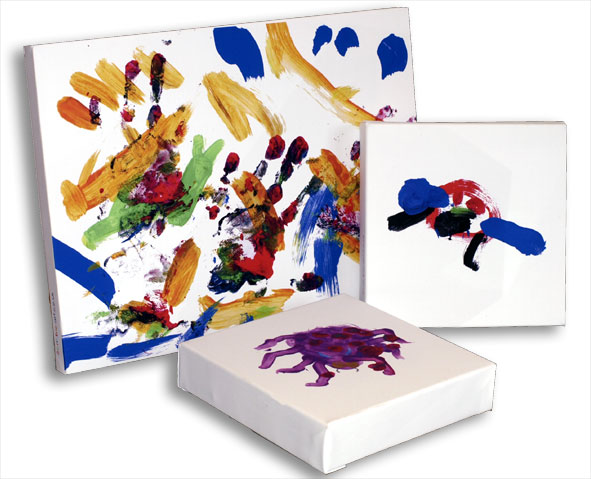
Finally of course, if all else fails, you can always cheat and ask me to put the masterpiece your child has produced on paper, onto canvas. This has the added advantage that it will be presented at its best, with all those creases, smudges and tears removed. Visit Artful Kids for full details.
This is only intended to be a very basic introduction to canvas as an art material - hopefully I haven't bored everyone rigid, but for anyone with a more serious interest in finding out about canvas as a painting support, there is of course lots more material out there on the internet. A few examples are given here:
Making a Hand Made Canvas for Painting on
How to Prime and Stretch a Canvas
The Artist's Canvas
Labels:
art,
artist,
canvas,
canvas board,
canvas paper,
Children's artwork,
kids,
painting
Monday, 4 January 2010
Creative ways to recycle Christmas Cards
The easiest way to recycle your old Christmas Cards is to take them all down to the nearest recycling point, but there are much more creative ways of recycling them. Here are a few suggestions:
Cut them along the fold, and use the blank side of each for shopping lists, notes etc. (This is something which my parents always did, and I have adopted the same habit!)
Use the pictures to make gift tags for next year, using decorative cutting scissors to create an attractive edge (again, this is a simple idea that has been around for years, saves money, and takes minimal effort).
Cut up the pictures themselves, and cut out individual motifs and messages to make next year's Christmas cards and gift tags. This is a little bit more creative, and involves more effort than the one above, but will result in something that is unique, and less obviously recycled from last year's cards. If you use sticky foam pads or glue dots to stick on the individual elements, it creates an attractive 3D effect which you see on lots of the handmade cards in the shops, and is really simple to do.
Cut out individual characters from the cards (e.g. snowmen, santa, reindeer, robins etc.) and attach them onto the top of a lolly stick with sticky tape to make a simple stick puppet. If you want to go the whole hog, you could also cut out elements of scenery (trees, houses etc.) from the cards too. Alternatively you can use these elements to create your own Christmas scene on dark coloured card, and paint on a simple snow background.
Cut up the picture to make a simple Christmas jigsaw.
Cut the picture up into small pieces, (either squares or more random shapes) and use to make mosaic patterns, or collages, as shown here (don't ask about the empty raisin boxes - they wanted to stick them on, so who am I to interfere with their creative innovations?)
The links below give some more ideas:
Let me know if you have any other creative ways of using old Christmas cards!
Cut them along the fold, and use the blank side of each for shopping lists, notes etc. (This is something which my parents always did, and I have adopted the same habit!)
Use the pictures to make gift tags for next year, using decorative cutting scissors to create an attractive edge (again, this is a simple idea that has been around for years, saves money, and takes minimal effort).
Cut up the pictures themselves, and cut out individual motifs and messages to make next year's Christmas cards and gift tags. This is a little bit more creative, and involves more effort than the one above, but will result in something that is unique, and less obviously recycled from last year's cards. If you use sticky foam pads or glue dots to stick on the individual elements, it creates an attractive 3D effect which you see on lots of the handmade cards in the shops, and is really simple to do.
Cut out individual characters from the cards (e.g. snowmen, santa, reindeer, robins etc.) and attach them onto the top of a lolly stick with sticky tape to make a simple stick puppet. If you want to go the whole hog, you could also cut out elements of scenery (trees, houses etc.) from the cards too. Alternatively you can use these elements to create your own Christmas scene on dark coloured card, and paint on a simple snow background.
Cut up the picture to make a simple Christmas jigsaw.
Cut the picture up into small pieces, (either squares or more random shapes) and use to make mosaic patterns, or collages, as shown here (don't ask about the empty raisin boxes - they wanted to stick them on, so who am I to interfere with their creative innovations?)
The links below give some more ideas:
Let me know if you have any other creative ways of using old Christmas cards!
Labels:
art,
Children,
Christmas cards,
gift tags,
kids,
mosaic,
recycling,
stick puppets
Tuesday, 22 December 2009
Display Ideas No.2
Frames Wallpaper
This product has been around for a couple of years, so you may have come across it before, but I think it's a lovely idea for use in a child's bedroom or playroom. Kids can either colour in the frames directly, or alternatively you can stick paintings and drawings onto the frames. It's available from Graham and Brown. At £25 a roll, it's not especially cheap as wallpaper goes, but then I think it's something you could use in just a small area, as it might be a bit overpowering to do a whole room with it. I've always rather liked the idea of giving kids permission to decorate their own environment by drawing or painting directly on the walls - though it worries me slightly for younger children, who may not recognise the difference between the specific areas where they are allowed to do it, and any other wall they might feel inclined to embellish!
Labels:
art,
artwork,
children's room,
display,
kid's room,
wallpaper
Wednesday, 9 December 2009
Child Art Prodigies
Everyone loves the naivety and immediacy of children’s art, and will often joke that it is indistinguishable from the work of some well-known artists. But what if your child seems to have a genuine talent, what if in fact they appear to be a child prodigy?
The term 'child prodigy' is given to a child who is capable of excelling in at least one area of skill, at a level that is considered to be that of a highly trained adult in that field. Child art prodigies are relatively rare. There have been some well-documented cases throughout the history of art, including Leonardo da Vinci, and Picasso (who painted ‘The Picador’ at the age of just 8), but many of these did not display ‘adult’ levels of skill until they were a little older, for example John Everett Millais, who entered the Royal Academy Schools at the age of 11, and JMW Turner who was elected as a member of the Royal Academy itself at the age of just 15. (John Constable didn't achieve this until he was 52). This was perhaps inevitable at a time when representational art, in the western world at least, was pretty much universal. However with the advent of abstract art, and expressionist art in particular, child prodigies have got ever younger, and 2 - 4 years old appears to be the age at which any self-respecting child art prodigy has their first exhibition these days.
One of the most well-known examples is that of Marla Olmstead, who sold her first painting for $253 at the age of 2. Since then, some of her paintings have been sold for many thousands of dollars. Some art critics think that she has an impressive ability to paint in layers, and fill the canvas instead of painting in one layer and leaving most of the canvas blank (I’m not too sure that this is especially rare - certainly my 3 year old does this, but then maybe it’s because I give him small pieces of paper instead of large canvases!) Marla is from an artistic family, but there is a certain amount of controversy about her work, with some critics suggesting that what she does is no more than most children of her age would achieve if they had some additional coaching.
A more recent case which sprang up in Australia earlier this year, is that of Aelita Andre - another 2 year old toddler whose abstract artwork has been selling for between $240-$1400. Again, there is some debate as to whether it is all her own work (her parents are both artists) though her parents insist that it is. When her work was first selected for exhibition, her parents apparently neglected to tell the gallery owner that the work was by their 2 year old daughter. Perhaps that wasn’t important, after all the work did sell. You can see more of Aelita's work at her website.
Along with all the hype, there have been accusations of child exploitation. I must admit I was tempted to try this the other day when my 3 year old produced a beautiful abstract painting, all swirls of gorgeous colour which any professional artist would have been proud of. For a brief moment I toyed with the idea of passing it off as my own, and selling it for vast sums of money, but for him it was a work in progress, and although I tried to persuade him to stop there and then, the ‘less is more’ argument cut no ice, and I had to watch in distress as he turned it to mud - it was after all his painting. However it hasn’t stopped me using some of my elder son’s drawings on some of the nursery artwork I sell (he takes a fee for this!) They lend a wonderful naïve charm, and he’s happy enough to produce them. I fear neither of us are going to get rich though. These were however one of the catalysts behind the development of Artful Kids. After all, any child’s drawing can be used, and I figured it would be a lovely way for an older sibling to get involved with helping to decorate a younger child’s bedroom.

My own feeling is that the significant thing with these very early ‘prodigies’ is that these are children who are given acrylic paints, large canvases, and the support and encouragement of their artistically trained or educated parents. This by itself would make such children unusual, add this to a little natural talent, some marketing and PR, and hey presto, you have a ‘prodigy’. This is not to belittle any skill that they do have, but child prodigies rarely become adult geniuses - what gets the attention of the media, is the young age of the child more than the quality of the artwork itself, and as with most aspects of normal child development, eventually many of their peers will catch up, or even overtake.
There is a danger that the parents of such children put their own needs first, massaging their egos through reflected glory, rather than considering the effect that all the attention may have on the young child, and what might happen when that attention goes away, as it inevitably will. Having said all that, Marla Olmstead is still painting and selling her work at the age of 9 - but only time will tell if she will be as famous as an adult artist, as she has been as a child. You can judge her work for yourself on her website
You can read another of my posts about Child Art Prodigies here.
Flickr Photo Credits:
The term 'child prodigy' is given to a child who is capable of excelling in at least one area of skill, at a level that is considered to be that of a highly trained adult in that field. Child art prodigies are relatively rare. There have been some well-documented cases throughout the history of art, including Leonardo da Vinci, and Picasso (who painted ‘The Picador’ at the age of just 8), but many of these did not display ‘adult’ levels of skill until they were a little older, for example John Everett Millais, who entered the Royal Academy Schools at the age of 11, and JMW Turner who was elected as a member of the Royal Academy itself at the age of just 15. (John Constable didn't achieve this until he was 52). This was perhaps inevitable at a time when representational art, in the western world at least, was pretty much universal. However with the advent of abstract art, and expressionist art in particular, child prodigies have got ever younger, and 2 - 4 years old appears to be the age at which any self-respecting child art prodigy has their first exhibition these days.
One of the most well-known examples is that of Marla Olmstead, who sold her first painting for $253 at the age of 2. Since then, some of her paintings have been sold for many thousands of dollars. Some art critics think that she has an impressive ability to paint in layers, and fill the canvas instead of painting in one layer and leaving most of the canvas blank (I’m not too sure that this is especially rare - certainly my 3 year old does this, but then maybe it’s because I give him small pieces of paper instead of large canvases!) Marla is from an artistic family, but there is a certain amount of controversy about her work, with some critics suggesting that what she does is no more than most children of her age would achieve if they had some additional coaching.
A more recent case which sprang up in Australia earlier this year, is that of Aelita Andre - another 2 year old toddler whose abstract artwork has been selling for between $240-$1400. Again, there is some debate as to whether it is all her own work (her parents are both artists) though her parents insist that it is. When her work was first selected for exhibition, her parents apparently neglected to tell the gallery owner that the work was by their 2 year old daughter. Perhaps that wasn’t important, after all the work did sell. You can see more of Aelita's work at her website.
Along with all the hype, there have been accusations of child exploitation. I must admit I was tempted to try this the other day when my 3 year old produced a beautiful abstract painting, all swirls of gorgeous colour which any professional artist would have been proud of. For a brief moment I toyed with the idea of passing it off as my own, and selling it for vast sums of money, but for him it was a work in progress, and although I tried to persuade him to stop there and then, the ‘less is more’ argument cut no ice, and I had to watch in distress as he turned it to mud - it was after all his painting. However it hasn’t stopped me using some of my elder son’s drawings on some of the nursery artwork I sell (he takes a fee for this!) They lend a wonderful naïve charm, and he’s happy enough to produce them. I fear neither of us are going to get rich though. These were however one of the catalysts behind the development of Artful Kids. After all, any child’s drawing can be used, and I figured it would be a lovely way for an older sibling to get involved with helping to decorate a younger child’s bedroom.

My own feeling is that the significant thing with these very early ‘prodigies’ is that these are children who are given acrylic paints, large canvases, and the support and encouragement of their artistically trained or educated parents. This by itself would make such children unusual, add this to a little natural talent, some marketing and PR, and hey presto, you have a ‘prodigy’. This is not to belittle any skill that they do have, but child prodigies rarely become adult geniuses - what gets the attention of the media, is the young age of the child more than the quality of the artwork itself, and as with most aspects of normal child development, eventually many of their peers will catch up, or even overtake.
There is a danger that the parents of such children put their own needs first, massaging their egos through reflected glory, rather than considering the effect that all the attention may have on the young child, and what might happen when that attention goes away, as it inevitably will. Having said all that, Marla Olmstead is still painting and selling her work at the age of 9 - but only time will tell if she will be as famous as an adult artist, as she has been as a child. You can judge her work for yourself on her website
You can read another of my posts about Child Art Prodigies here.
Flickr Photo Credits:
Subscribe to:
Posts (Atom)


